


In terms of civil engineering, a modern nuclear power plant is more like a medium-sized industrial building, because the special features and advantages of the small modular reactors (SMRs) arise from the fact that they may be built according to a standard design, and this speeds up and simplifies the installation of reactors at the nuclear power plant site significantly. Although SMRs are designed to have a long service life (in the range of 30-60 years), it is entirely appropriate to ask what will happen to a nuclear power plant once it has served its purpose. Who will pay for the dismantling and demolition work in the future, and who will pay for the final disposal of spent nuclear fuel?
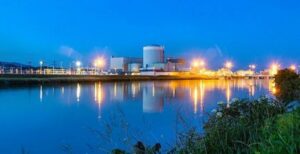
The Krško nuclear power plant, jointly operated by Slovenia and Croatia
The decommissioning of nuclear facilities is a process that leads to the complete or partial irreversible closure of a nuclear facility (usually a nuclear reactor). The ultimate goal of decommissioning is to terminate the operation of the nuclear facility and the licence issued for it. The process itself is strictly governed by a decommissioning plan established by the regulator, which covers the complete or partial dismantling and decontamination of the nuclear facility. The decommissioning plan is drawn up before the facility itself is built. The ideal goal of decommissioning is to restore the environment to its pre-nuclear facility “green state”. The plan is considered as completed when the approved final state of the facility has been achieved.
Global experience to date has shown that the decommissioning process takes approximately 15-30 years, or even longer if necessary, if an interim storage period is applied to ensure the safe decay of radioactive waste. After decommissioning, the remaining radioactive waste is transported either to an on-site (interim) storage facility, where it remains under the control of the owner, or to a final off-site disposal facility.
Interim storage can last for decades
The final disposal of nuclear waste generated during the decommissioning of past and future nuclear facilities has so far been a problem without a good solution. On one hand, there has been no rush to find a final disposal solution, because the safe interim storage can easily last for decades. On the other hand, there has been no good universal technical solution for final disposal.
As things stand today, it is hoped that the rapid technological developments enable the reuse of most of the spent nuclear fuel by new types of reactors, and this will significantly reduce the amount of waste requiring final disposal. Several final disposal sites for spent nuclear fuel in deep layers of the earth’s crust have entered into the design and construction phase, e.g. the one currently built by our northern neighbours in Finland.
Decommissioning is largely an administrative and technical process
A nuclear facility is dismantled so that it no longer requires radiation protection measures. This also includes the cleaning and decontamination of radioactive materials, including nuclear power plant buildings and equipment, and, if necessary, demolition works. Once a facility has been completely decommissioned, it no longer poses a radiation hazard. The licence issued for the construction and operation of the nuclear facility is terminated, the facility is released from state supervision, and the licence holder is released from responsibility for nuclear safety. In future, the owner of a decommissioned nuclear facility may use or produce whatever they deem appropriate and useful, just as in any other industrial building.
It is important to remember that there are millions of small nuclear devices and facilities around the world, as well as nuclear material that is used not only for electricity generation but also for medical, industrial and scientific purposes, which must also be decommissioned when their intended use ends.
Decommissioning costs are collected in advance and held in a separate fund
Decommissioning costs must be covered by the amounts estimated during the design and construction of the nuclear facility and specified in the decommissioning plan. The decommissioning plan is part of the permitting process for the construction, testing and operation of the nuclear facility. The amounts accumulated from regular payments made by the operator of the nuclear facility during the period of use of the facility may be held and managed in a special-purpose decommissioning fund.
The purpose of such a fund is to ensure that sufficient financial resources are available at all times until the completion of the decommissioning programme. Also, the decommissioning fund ensures the financing of institutional control over the post-closure monitoring of the nuclear facility. In accordance with the ‘polluter pays’ principle, the producer of the nuclear waste shall contribute all the financial resources necessary for the decommissioning of the nuclear facility.
The decommissioning fund is financed by the operators of nuclear facilities.
The amount and payment schedule of the payments into the decommissioning fund must take into account the potentially very long duration of the final disposal programme andextend from the initial financing of the project to the actual incurrence of any decommissioning costs.
When determining the amount of payments to the fund and the basis for their calculation, a waste management fee-based approach, which is based on the amount of electricity produced using nuclear fuel, can also be considered.
Another option is to require the producers of nuclear waste to pay a one-off fee to the waste manager upon transfer of the nuclear waste. This would presume the application of a system of waste tariffs for different categories of waste. A combination of both systems could also be applied to electricity producers and other institutional waste producers.
Contributions to the decommissioning fund should motivate efficient electricity production
Applying the principle of a waste tariff to contributions to the decommissioning fund in relation to the amount of waste generated should motivate waste producers to reduce their waste volumes by maximising the recovery and recycling of nuclear materials. When designing such “tariffs”, it is reasonable to take into account also other factors, such as the activity level or toxicity of the waste.
The most common mechanism used to finance decommissioning funds is a levy on nuclear electricity. For example, the rates applied are 0.1 ¢/kWh in the United States, 0.14 ¢/kWh in France, or 0.2 ¢/kWh in Romania. In some countries, the waste producers pay larger one-off amounts to the fund on a regular basis (e.g. South Korea), while in others (e.g. Hungary), a ´decommissioning fund was established on the basis of the state budget for historical reasons.
Payments to the decommissioning fund should be adjusted periodically
When establishing a decommissioning fund, the target size of the fund must be determined as sufficient to cover the anticipated decommissioning costs in the future. From this, the schedule of contributions to the fund can be derived.
One of the major uncertainties related to the accumulation of the decommissioning fund is the very long timeframe of the decommissioning programme, because the timeframe affects the discounted costs. In order to reduce the uncertainty associated with changes and refinements to the initial assumptions of costs over time, it is reasonable to periodically review the fund’s contribution plan and adjust it if necessary. The fund manager and the institutions supervising it could have the right to do so on a mandatory basis.
A more safe conservative approach is more expensive
Not discounting future costs may be a more conservative approach, as it leads to faster accumulation of provisions. In this case, the amount necessary to cover the obligation is accumulated as soon as the obligation arises.
However, the useful life of the facility may be shorter than expected, or future waste volumes may be higher than forecast, and this may result in insufficient funding of the decommissioning fund. The risk of insufficient funding can be mitigated by applying a forward-looking prepayment based payment schedule, which time period is is shorter than the planned useful life of the nuclear facility.
It is also true that until nuclear fuel is loaded into the reactor, the costs of decommissioning the plant are not very significant. After the nuclear reactor starts operating, the decommissioning budget will be much larger. It would be unreasonable to require the operator of a nuclear facility to deposit the entire amount necessary for decommissioning of the facility into the fund upfront. Instead, the use of reliable and liquid financial instruments (e.g. bank guarantees) should also be considered.
The decommissioning fund must be managed conservatively and its liquidity maintained at all times.
There are several different models for managing decommissioning funds in use around the world. A distinction is made between so-called internal funds (managed by the waste producers themselves) and external funds, which are managed by organisations separate and independent from the waste producers or by a government agency.
An external fund certainly offers a more transparent management model, which makes it easier to check whether the collected funds are still available, sufficient and used for their intended purpose. It also protects the collected funds in the event of the unexpected termination or cessation of the operator’s activities. A good example from Estonian practice is the national Guarantee Fund, established by law, which purpose is to protect the money deposited in credit institutions in the event of insolvency.
The resources accumulated in the decommissioning fund could only be invested on the basis of a sufficiently conservative investment strategy. The risk that the return on investments achieved by the fund manager may be lower than expected must be taken into account. Another important risk to be considered is the liquidity risk, as the decommissioning fund’s assets must be always available should the necessity arise.
